
Where is Israel's Throne?
Is Your Bible Authorized? By Whom?
Could the tradition that the British monarchy is the kingly line of David, crowned on the Stone of Jacob, be subjected to scientific scrutiny? The Royals have silently claimed it for centuries and have paid great honour to The Stone.
2021 marked the sixty-nineth anniversary of the coronation of Queen Elizabeth II of the United Kingdom on June 2, 1953. Surely her nearly seventy year reign would be the envy of many ancient kings, who considered one measure of their greatness to be the length of their reign. Great Britain has been a world power for centuries, and heads the Commonwealth of Nations which spans the globe with nearly fifty member countries.
How could a few small islands have come to have such widespread influence?
Just who are the British anyway?

When one traces the roots of the Britons, Scots, Irish, Welsh, English (Anglos and Saxons), Picts, Normans, and Celts, there is substantial evidence that all of those peoples are of Israelite descent. The tribe of Joseph seems to be best represented, but there is evidence for the presence of several of the tribes. Volumes have been written on that subject, but in this article, it will be taken as a starting point that the inhabitants of the British Isles have a lot of the blood of Israel. Because of this anniversary date of the monarchy, let us focus on the succession of British royalty.
1. King David's Throne
There is a strong tradition that the British royal line is the continuation of the throne of King David of the ancient "United Kingdom" of Israel and Judah. An examination of the genealogies of those kings clearly shows their descent from that royal line. The Lord made a covenant with King David, which was not conditional on David's continued righteousness.
The LORD declared:
I have made a covenant with my chosen, I have sworn unto David my servant,
Thy seed will I establish for ever, and build up thy throne to all generations. . . .
I have found David my servant; with my holy oil have I anointed him:
With whom my hand shall be established: mine arm also shall strengthen him.
Also I will make him my firstborn, higher than the kings of the earth.
My mercy will I keep for him for evermore, and my covenant shall stand fast with him.
His seed also will I make to endure for ever, and his throne as the days of heaven.
If his children forsake my law, and walk not in my judgments;
If they break my statutes, and keep not my commandments;
Then will I visit their transgression with the rod, and their iniquity with stripes.
Nevertheless my lovingkindness will I not utterly take from him, nor suffer my faithfulness to fail.
My covenant will I not break, nor alter the thing that is gone out of my lips.
Once have I sworn by my holiness that I will not lie unto David.
His seed shall endure for ever, and his throne as the sun before me.
It shall be established for ever as the moon, and as a faithful witness in heaven. (Psalms 89:3-4, 20-37)
Thus, the Lord covenanted that, notwithstanding their potential wickedness, the descendants of David would rule as kings over Israel forever. If they became wicked, then they could bring calamity on themselves and their subjects, but their kingly line would continue. That's an amazing prophecy. All it would take to break it that the monarchy be overthrown, or to have no royal descendant who could inherit the throne.
So has the royal line continued unbroken? It clearly was continuous for some four centuries until the time of king Zedekiah, last King of Judah in Jerusalem. In 587 B.C., at the fall of Jerusalem to Babylon, King Zedekiah, of the royal line of David, saw his sons slain before his eyes (Jer. 39:6). It was apparently Nebuchadnezzar's attempt to end the succession of Jewish kings, but there was a detail of the Hebrew law with which he was apparently unfamiliar. A princess could also inherit the throne if she married someone from the tribe of Judah (Num. 27:8; 36:3). So what about the daughters of Zedekiah?
We are explicitly told that the daughters of Zedekiah were taken to Egypt along with the prophet Jeremiah and others (Jer. 43:6). There Jeremiah prophesied that all those who fled to Egypt would also be killed, except a few who should escape (Jer. 44:1-14).
That is where the Biblical story of Jeremiah ends, except for the hint that Jeremiah's mission was not only to tear down, but also to plant (Jer. 1:10). No planting is described in his mission in Jerusalem. Where did Jeremiah do his planting? And where was the new kingdom described in the parable given to Ezekiel, where a "tender twig," cut from the highest branch of the high cedar, would be planted and grow into a great kingdom, and that the lower tree would be exalted above the upper? (Ezek. 17:22-24) That tender twig may well have been the daughter of Zedekiah.
For the "rest of the story" we must turn to the history of ancient Ireland. The following account is summarized from authenticated histories rather than mere legends or speculation.
2. Jeremiah and the Scottish Royalty
The earliest known colonizers of Ireland were the Danai, who almost certainly were from the tribe of Dan. They had separated from the other tribes shortly after the Exodus, and founded some cities in Greece, including Athens.[5] About 1200 B.C. a colony of Danai from Greece journeyed to Ireland. Centuries later a group of Israelites called the Milesians arrived and subjugated the Danai. The Milesians were either the same as, or joined with, the Scots, who had migrated to Ireland from Scythia (Scotia = Scythia), near the Black Sea.
The Flag of Northern Ireland combines the Star of David (Pharez) with the Red Hand (Zerah).

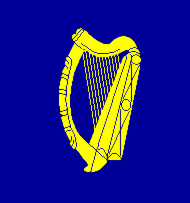
The Harp is the Symbol of Ireland on the Royal Flag.
2.1 Ollam Fodhla
The Harp is the Symbol of Ireland on the Royal Flag.
What has all of this got to do with our story? Some versions identify Scota as the daughter of King Zedekiah, Ollam Fodhla as Jeremiah, and Berach as his scribe Baruch.[11] But wasn't Scota the daughter of Pharaoh? Remember that "pharaoh" is simply the Egyptian word for king, and Zedekiah's daughter certainly was a king's daughter who was in Egypt.
The traditions also state that the small group who thus escaped from Egypt took with them to Ireland the harp of David, the ark of the covenant, and the stone of Jacob.
It states that King Eochaidh was coronated by Jeremiah in Ireland while sitting on the stone of Jacob, and some versions add that his wife Teah was the sister of Scota and also a daughter of Zedekiah. The harp of David became a national emblem of Tara and of Ireland.
2.1 Ollam Fodhla
The Harp is the Symbol of Ireland on the Royal Flag.
What has all of this got to do with our story? Some versions identify Scota as the daughter of King Zedekiah, Ollam Fodhla as Jeremiah, and Berach as his scribe Baruch.[11] But wasn't Scota the daughter of Pharaoh? Remember that "pharaoh" is simply the Egyptian word for king, and Zedekiah's daughter certainly was a king's daughter who was in Egypt.
The traditions also state that the small group who thus escaped from Egypt took with them to Ireland the harp of David, the ark of the covenant, and the stone of Jacob.
It states that King Eochaidh was coronated by Jeremiah in Ireland while sitting on the stone of Jacob, and some versions add that his wife Teah was the sister of Scota and also a daughter of Zedekiah. The harp of David became a national emblem of Tara and of Ireland.
2.2 The Stone of Destiny
All the kings of the Scots in Tara were coronated on that stone for over a thousand years. Then about A.D. 500, Fergus of Ireland conquered the Picts who lived in Scotland. The Picts agreed to accept him as king, so he had the Stone of Destiny moved to Scotland, where he was crowned on it. It thereafter also became known as the Stone of Scone (pronounced "Scoon") because it resided at the castle there. True to the prophecy, that land where the stone resided was ruled by a Scottish king, and became known as Scotland. Later, King James VI of Scotland became James I of England, and today Queen Elizabeth is his descendant. Thus, even now that Scotland forms part of Great Britain, it is still true that the Scots are ruled by a monarch of Scottish royal descent.
The Stone of Destiny was moved to Westminster Abbey in London, England,[13] in 1296 A.D. by King Edward I. He had a special "coronation chair" built around that stone, and all of the British kings and queens have been crowned in that chair since, including the currently reigning Queen Elizabeth II. In 1996 the stone was returned to Scotland.
2.3 Were Davidic Kings Coronated on the Stone?
The Coronation ceremony appears to have been taken as directly as possible from the description in the Bible of the coronation of David and Solomon. The monarch is anointed with sacred oil by the Archbishop of Canterbury, trumpets sound, and the people shout "God Save the King" (1 Samuel 10:24, 1 Kings 1:39). The royal crown contains twelve jewels made of the same twelve stones which were in the breastplate of the high priest (Ex. 28:17-21). These similarities alone do not prove that the kings really are the royal blood of Israel, but such would be expected if the British throne is the continuation of the throne of David. Of course, the royalty also have extensive genealogies to prove their lineage and no one seems to doubt or challenge such a lofty claim.

The Coronation Chair was built around the Stone of Scone (just below the seat).
It is interesting to note, however, that although the stone is not explicitly mentioned as part of the Biblical coronation ceremony, there seem to be references to it that have been overlooked. Consider the following accounts of when King Joash of Judah was anointed by the high priest Jehoiada:
And when she looked, behold, the king stood by a pillar, as the manner was, and the princes and the trumpeters by the king, and all the people of the land rejoiced and blew with trumpets (2 Kings 11:14)
Then they brought out the king's son, and put upon him the crown, and gave him the testimony, and made him king. And Jehoiada and his sons anointed him, and said, God save the king. Now when Athaliah heard the noise of the people running and praising the king, she came to the people into the house of the LORD:
And she looked, and, behold, the king stood at his pillar at the entering in, and the princes and the trumpets by the king: and all the people of the land rejoiced and sounded with trumpets, also the singers with instruments of musick, and such as taught to sing praise. (2 Chronicles 23:11-13)
Here we are told that along with the usual parts of the coronation ceremony, that also the king stood at his pillar, as was the custom at coronation. What does that mean? Some Bible translations are more literal and render it, "The king stood on the pillar." [15] How can one stand on a pillar? It turns out the word translated pillar comes from the root meaning "to stand" and can also refer to a "stand" or "platform." The meaning of pillar comes from the idea that a pillar is standing up on its end. So the verses could also be saying that the king was coronated while standing on his stand, as was the custom. Was that stand or pillar the Stone of Destiny?
If so, just what is it that makes this stone so special?
It was called the Stone of Jacob.
Just what was the stone of Jacob?
3. The Rock of Israel
The is a strange story in the Book of Genesis, which has been somewhat enigmatic. In the light of knowing about the traditions surrounding the Stone of Destiny, and knowing its size and shape, and knowing that authentic or not, an unbroken chain of kings has been crowned on that stone for centuries, the following history now makes a lot more sense. Nearly two thousand years before Christ, the Prophet Jacob (as in "Abraham, Isaac and Jacob"), was traveling back to the land of Haran to choose a wife. When he passed by a city named Luz, the following event occurred: And he lighted upon a certain place, and tarried there all night, because the sun was set; and he took of the stones of that place, and put them for his pillows, and lay down in that place to sleep. And he dreamed, and behold a ladder set up on the earth, and the top of it reached to heaven: and behold the angels of God ascending and descending on it. And, behold, the LORD stood above it, and said, I am the LORD God of Abraham thy father, and the God of Isaac: the land whereon thou liest, to thee will I give it, and to thy seed; And thy seed shall be as the dust of the earth, and thou shalt spread abroad to the west, and to the east, and to the north, and to the south: and in thee and in thy seed shall all the families of the earth be blessed.

And, behold, I am with thee, and will keep thee in all places whither thou goest, and will bring thee again into this land; for I will not leave thee, until I have done that which I have spoken to thee of. And Jacob awaked out of his sleep, and he said, Surely the LORD is in this place; and I knew it not.And he was afraid, and said, How dreadful is this place! this is none other but the house of God, and this is the gate of heaven.
And Jacob rose up early in the morning, and took "the stone" that he had put for his pillows (his head stone), and set it up for a pillar, and poured oil upon the top of it. Genesis 28:18
And he called the name of that place Bethel: but the name of that city was called Luz at the first. (Genesis 28:11-19).
This account includes several puzzling features. First, a stone small enough to use as a pillow seems hard to imagine being set up as a pillar. Second, just because he had a dream about how the multitudes of his posterity would spread out all over the world, why would he anoint his pillow stone with oil? And what did he mean that the stone would be for God's house? It was important enough that he renamed the place Bethel,[16] which means "House of God." Did it have something to do with a temple?
3.1 The Stone of Jacob The size and shape of Stone of Destiny help make sense of this account, in case it really is this stone of Jacob. First, it is in fact about the size and shape of a big pillow, being about 26 x 16 x 10 inches. It was apparently already a stone that had been cut into a rectangular building shape when Jacob found it. It was probably rejected by the builders because it has a crack in it, so it had been discarded before being finished. If the Stone of Destiny really is Jacob's stone, then it is easy to see how he could stand it up on its end to be a "pillar." Actually, it might have been difficult because it weighs over 300 pounds. Checking the meaning of the word translated "pillar," we see that it means a "stone marker," which often were very large pillars. Most likely this one served mostly as a marker so that he could find the location when he returned as well as remember the stone that his head rested upon when God visited him.

3.2 The Stone of Israel Symbolized Christ
There is evidence in the Bible the it might well have been this stone which was specifically indicated to have been the "stone of Israel" which symbolized Jesus Christ. During the blessing of Jacob to Joseph, he inserted parenthetically, "from thence is the shepherd, the stone of Israel" (Gen. 49:24, compare D&C 50:44).
Although I couldn't find any place where the Bible states explicitly that the stone of Jacob accompanied the Israelites during their exodus from Egypt,[17] Paul seems to imply it. He compares physical things such as the manna, water, and a rock which "followed" them to their spiritual counterparts which all symbolize Jesus Christ (1 Cor 10:4):
MOREOVER, brethren, I would not that ye should be ignorant, how that all our fathers were under the cloud, and all passed through the sea;
And were all baptized unto Moses in the cloud and in the sea;
And did all eat the same spiritual meat;
And did all drink the same spiritual drink: for they drank of that spiritual Rock that followed them: and that Rock was Christ. (1 Corinthians 10:1-4)
Thus, it could be that the Rock of Salvation (Psalms 95:1) which shepherded the Israelites, apparently referred to the physical Stone of Jacob that represented His anointing as the first Prince of, and Israel himself. (And he said, Thy name shall be called no more Iacob, but Israel: for as a prince hast thou power with God, and with men, and hast preuailed. Gen 32;28). Of course, as Paul explained, it was symbolic of Jesus Christ, who also identified himself as the Good Shepherd of Israel (John 10:11). If the identification with the Stone of Scone is correct, then it is a very plain looking piece of calcareous sandstone[18], so ordinary that in preparing this article I noticed that several web pages describing the Stone of Scone were scoffing at how plain it is for the royalty to make such a fuss about. Thus, it has "no form nor comeliness" and "no beauty" that is should be desired, which is exactly how the Savior is described (Isa. 53:2). That led to it being "despised and rejected of men" (Isa. 53:3). Yet, for centuries the royal families have coronated their princes and princess upon it?
3.3 Rejected by the Builders
It may not only have been the original builders who discarded the stone. There is also a tradition that when it came time to build the temple of Solomon, that the stone of Jacob, which was associated with the house of God from the beginning, should be included. But the builders rejected it because of the crack in it. There seemed to be no way that it could be a cornerstone to a temple.[19] Nor did it seem to the Jews who saw the Savior that there was any way that he could be the Messiah, the cornerstone of their religion. Thus, both were despised and rejected. David prophesied that the stone would be rejected (Psa. 118:22), and Jesus identified himself as fulfilling that prophecy. He explained that the "stone which the builders rejected, the same is become the head of the corner" (Mat. 21:42, compare Acts 4:11). Knowing Jesus Christ is the Rock of Israel (2 Sam. 23:3), we have long understood that scripture in the spiritual sense. But now that we learn about the Stone of Jacob, we see that the prophecy might well have been fulfilled in the physical sense also.
Is the Stone of Scone indeed the Stone of Jacob, which Jeremiah brought to Ireland, and on which British royalty has been coronated for so many centuries? Is there any way to verify these traditions, or will such ancient claims remain forever impossible to verify?
4. Geological Evidence
In the age of modern scholarship, it has become fashionable to demote all ancient history and tradition to the realm of legend, myth, and fantasy. In many cases, that is like throwing out the baby with the bathwater because there is usually a core of truth handed down in legend. In preparing this article, browsing the web for the "Stone of Scone" led to more articles ridiculing the traditions than those giving them any credence at all. Modern writers have assumed the Stone of Scone must have originated from a local quarry.
I am only aware of two scientific attempts to determine the origin of the stone. The first was by Professor Totten of Yale University. In response to suggestions that it had come from a local quarry, he issued the statement:, "The analysis of the stone shows that there are absolutely no quarries in Scone or Iona wherefrom a block so constituted could possibly have come, nor yet from Tara."[20]
The second study was done by Professor Odlum, who was a geologist and professor of theology at Ontario University. He made microscopic examinations of the stone, comparing it to quarries in both Scotland and Ireland, and found it dissimilar to stones from those areas. He became intrigued by the idea that it might really be the stone of Jacob. That hypothesis could be tested scientifically by searching to see if a similar type of rock is found near Bethel, where Jacob found his stone. After considerable searching, he found some strata rather high near a cliff that had exactly the type of composition he was looking for. He chipped off a piece and later performed microscopic tests. He concluded that his sample "matched perfectly" with the coronation stone.[21]
Desirous for even better proof he sought to get a little piece the size of a pea from the coronation stone, on which he could perform chemical tests. When he petitioned the Archbishop of Canterbury for such a piece, the reply was that it would take an act of Parliament signed by the King, and even then he wouldn't provide it.
To the best of my knowledge that was the end of a really fine scientific experiment that could at least partially validate the claim that the stone might have come from Bethel. This is an excellent example of how science can indeed be used to validate historical traditions. They cannot provide proof, but can greatly add to the credibility of a story. What is needed now is a really thorough scientific study of the stone to verify its authenticity.
5. Conclusion
Preliminary geological studies have indicated that the Stone of Destiny, upon which British monarchs have been crowned for centuries might indeed be the stone of Jacob as tradition asserts because it matches a formation near Bethel, the Biblical location of the stone the prophet Jacob found. However, the amazing devotion of the royals to The Stone and they centuries of coronations seem to further evidence it's probability of being "The Rock of Ages" which has represented the very throne of the house of Israel and of David. Further scientific testing is now required, such as a thorough chemical composition comparison, and even that can only confirm the possibility that the stone is authentic. In any case, on this sixty-nineth anniversary of the coronation of Queen Elizabeth II, we can pause to pay respect to what very well might be the continuation of the unbroken line of succession of kings reigning over the physical and spiritual children of Israel, from King David, over three thousand years ago.
The Story (folklore or history?)
"The sceptre shall not depart from Judah, nor a lawgiver from between his feet, until Shiloh come; and unto him shall the gathering of the people be." Genesis 49 :10
According to Irish tradition and legend, one of the two daughters of King Zedekiah, Tea Tephi married Prince Eochaidh of Ireland who was himself descended from Zerah, the child who had the scarlet thread tied around his wrist in Genesis 38. They went on to become the Irish King and Queen from which the Irish monarchy were descended from. Queen Tea Tephi was one of the so-called Princesses of the Harp who may have carried the Stone of Destiny, Jacob's pillow (see Genesis 28 verse 18, and 2 Kings 11 verses 12-14) over to Ireland which has been used in the coronation of Irish, Scottish and British monarchs for centuries. According to legend, the stone was reverently carried through Egypt, Sicily and Spain, reaching Ireland around 700 B.C. Known in Ireland as Lia Fail it rested on the hills of Tara where Irish kings were crowned. More specifically, the legend goes that it was taken to Egypt with the Israelites, then to Spain with Jeremiah the prophet accompanying Tea Tephi and her sister Scota. While there are a number of theories about Tea Tephi and Scota, for example some suggest that Scota was the daughter of an Egyptian Pharoah, there is, however, a powerful body of evidence for the ultimate transfer of the House of Judah's monarchic line from David going from Israel to Ireland. Historical documentation claims that Scota married Gaythelos, son of the King of Greece, in Spain, and the stone of destiny went to Ireland with Jeremiah, Tea Tephi, Scota and her sons, Hyber and Hymec. They landed in the north and named it Olister (Ulster). There it became the oracular Coronation Stone of Tara on which, for about a thousand years, the kings of Ireland were crowned. The Scotti tribe in Ireland are said to have their name derived from Scota. Around 500 AD it was taken by them to Argylshire, South Western Scotland, and became the coronation stone of the Scottish kings. It was stolen from Scotland by King Edward I in 1296 and returned to Scotland in 1996, 700 years later by the United Kingdom government. There is a theory that the real stone was hidden by monks and the one captured by Edward in Scone Palace was different, but either way it can be argued that there is continuity in its purpose. In Ezekiel 21 verses 26-27 it says "Thus saith the Lord GOD; Remove the diadem, and take off the crown: this shall not be the same: exalt him that is low, and abase him that is high. I will overturn, overturn, overturn, it: and it shall be no more, until He come whose right it is; and I will give it Him."
Three times the scepter of Judah will be overturned, then it will remain until Jesus returns to sit on His throne. So the scepter never departs from the tribe of Judah. David never ceases to have a descendant sit on the throne over Israel fulfilling the prophecy of Psalm 89 verses 3-4 "I have made a covenant with my chosen, I have sworn unto David my servant, Thy seed will I establish for ever, and build up thy throne to all generations." The scepter going Judah to Ireland can be regarded as the first overturn. Ezekiel 17:24 could be referring to Pharez as the high tree and Zerah as the low tree, "I the Lord have brought down the high tree, have exalted the low tree, have dried up the green tree, and have made the dry tree to flourish: I the Lord have spoken and have done it." Documentation strongly suggests the King of Ireland having descended from the scarlet thread bloodline; the line of Zerah, and joined to the line of Pharez by Zedekiah's descendants.
The second overturn was from Ireland to Scotland, through Fergus, who sent for Lia Fail (Gaelic), the Stone of Destiny, and had it brought from Ireland to Western Scotland, where he was crowned. The third overturn was from Scotland to England in 1296, and cemented when King James VI of Scotland became King James I of England, continuing to Her Majesty Queen Elizabeth II, who was crowned with the Stone of Destiny present.
The Queen is the believed to be the lineal descendant of King David, who is of the tribe of Judah. The royal line of the Messiah comes through the tribe of Judah and continues until His second coming. Note the royal standard above sees King David's Harp (Ireland), the red rampant lion of the Zerah line of Judah (Scotland), and the three lions of the tribe of Judah. It is important also to note that it is documented that King William the Conqueror and the Normans were descendants of Judah which is significant because they introduced the lions emblem to England in the 11th Century. Jesus Christ is the Lion of The Tribe of Judah (Revelation 5 verse 5), and The King of Kings (Revelation 19 verse 16).
The final fulfillment of the prophecy is in the second coming of Jesus Christ to Earth to rule and reign for a thousand years in Jerusalem, (Revelation 20 verse 4) and ultimately forever (Revelation 22 verse 5).
UNBROKEN ROYAL SEED OF ISRAEL'S THRONE
1. Adam (B. C. 4000-3070), Eve.
2. Seth (B. C. 3869-2957).
3. Enos (B. C. 3764-2859).
4. Canaan (B. C. 3674-2895).
5. Mahalaleel (B. C. 3604-2709).
6. Jared (B. C. 3539-2577).
7. Enoch (B. C. 3377-3012).
8. Methusaleh (B. C. 3312-2344).
9. Lamech (B. C. 3125-2349).10. Noah (B. C. 2943-2007), Naamah.
11. Shem (B. C. 2441-1841).
12. Arphaxad (B. C.2341-1903).
13. Salah (B. C.2306-1873).
14. Heber (B. C. 2276-1812).
15. Peleg (B. C. 2241-2003).
16. Reu (B. C. 2212-1973).
17. Serug (B. C. 2180-2049).
18. Nahor (B. C. 2050-2002).
19. Terah (B. C. 2221-1992), Amtheta.20. Abraham (B. C. 1992-1817), Sarah.
21. Isaac (B. C. 1896-1716), Rebekah.
22. Jacob (B. C. 1837-1690), Leah. ----------------------------------------------------------------- THE STONE APPEARS AND NEVER DEPARTS?
23. Judah (b. B. C. 1752), Tamar.
24. Pharez.
25. Hezron.
26. Aram.
27. Aminadab.
28. Naasson.
29. Salmon.
30. Boaz (B. C. 1312), Ruth.
31. Obed.
32. Jesse.Kings of Israel/Judah33. King David (B. C. 1085-1015), Bathsheba.
34. King Solomon (B. C. 1033-975), Naamah.
35. King Rehoboam (b. B. C. 1016, d. 958), Maacah.
36. King Abijah (B. C. 958-955).
37. King Asa (B. C. 955-914), Azubah.
38. King Jehoshaphat (B. C. 914-889).
39. King Jehoram (B. C. 889-885), Athaliah.
40. King Ahaziah (B. C. 906-884), Zibiah.
41. King Joash (B. C. 885-839), Jehoaddan.
42. King Amaziah (b. B. C. 864, d. 810), Jecholiah.
43. King Uzziah (b. B. C. 826, d. 758), Jerusha.
44. King Jotham (b. B. C. 783, d. 742).
45. King Ahaz (b. B. C. 787, d. 726), Abi.
46. King Hezekiah (b. B. C. 751, d. 698), Hephzibah.
47. King Manasseh (b. B. C. 710, d. 643), Meshullemeth.
48. King Amon (b. B. C. 621, d. 641), Jedidiah.
49. King Josiah (b. B. C. 649, d. 610), Mamutah.
50. King Zedekiah (B. C. 599-578).Kings of Ireland51. Queen Tea Tephi (b. B. C. 565), marries Eochaidh, a Prince of the scarlet thread, later King Heremon, descended from Zerah.
52. King Irial Faidh (reigned 10 years).
53. King Eithriall (reigned 20 years).
54. Follain.
55. King Tighernmas (reigned 50 years).
56. Eanbotha.
57. Smiorguil.
58. King Fiachadh Labhriane (reigned 24 years).
59. King Aongus Ollmuchaidh (reigned 21 years).
60. Maoin.
61. King Rotheachta (reigned 25 years).
62. Dein.
63. King Siorna Saoghalach (reigned 21 years).
64. Oholla Olchaoin.
65. King Giallchadh (reigned 9 years).
66. King Aodhain Glas (reigned 20 years).
67. King Simeon Breac (reigned 7 years).
68. King Muirteadach Bolgrach (reigned 4 years).
69. King Fiachadh Toigrach (reigned 7 years).
70. King Duach Laidhrach (reigned 10 years).
71. Eochaidh Buailgllerg.
72. King Ugaine More the Great (reigned 30 years).
73. King Cobhthach Coalbreag (reigned 30 years).
74. Meilage.
75. King Jaran Gleofathach (reigned 7 years).
76. King Coula Cruaidh Cealgach (reigned 25 years).
77. King Oiliolla Caisfhiachach (reigned 28 years).
78. King Eochaidh Foltleathan (reigned 11 years).Lia Fail at Tara, Ireland79. King Aongns Tuirmheach Teamharch (reigned 30 years).
80. King Eana Aighneach (reigned 28 years).
81. Labhra Suire.
82. Blathucha.
83. Easamhuin Famhua.
84. Roighnein Ruadh.
85. Finlogha.
86. Fian.
87. King Eodchaidh Feidhlioch (reigned 12 years).
88. Fineamhuas.
89. King Lughaidh Raidhdearg.
90. King Criomhthan Niadhnar (reigned 16 years).
91. Fearaidhach Fion Feachtnuigh.
92. King Fiachadh Fionoluidh (reigned 20 years).
93. King Tuathal Teachtmar (reigned 40 years).
94. King Coun Ceadchathach (reigned 20 years).
95. King Arb Aonflier (reigned 30 years).
96. King Cormae Usada (reigned 40 years).
97. King Caibre Liffeachair (reigned 27 years).
98. King Fiachadh Sreabthuine (reigned 30 years.)
99. King Muireadhach Tireach (reigned 30 years).
100. King Eochaidh Moigmeodhin (reigned 7 years.)
101. King Nail of the Nine Hostages.
102. Eogan.
103. K. Murireadhach.
104. Earca.Kings of Argyleshire105. King Fergus More
106. King Dongard
107. King Conran
108. King Aidan (d. 604).
109. King Eugene IV. (d. 622).
110. King Donald IV. (d. 650).
111. Dongard.
112. King Eugene. V. (d. 692).
113. Findan.
114. King Eugene VII. (d. A. D. 721), Spondan.
115. K. Etfinus (d. A. D. 761), Fergina.
116. King Achaius (d. A. D. 819), Fergusia.
117. King Alpin (d. A. D. 834).Kings of Scotland118. King Kenneth I. (842-858).
119. King Constantin I. (862-876).
120. King Donald II. (889-900).
121. King Malcolm I. (943-954).
122. King Kenneth II. (971-995, d. A. D. 995).
123. King Malcolm II. (1005-1034, d. A. D. 1034).
124. Bethoc, married to Crinan, Mormaer of Atholl and lay abott of Dunkeld.
125. King Duncan I. (1034-1040, d. A. D. 1040), Sybil.
126. King Malcolm III. Canmore (A. D. 1058-1093), Margaret of England.
127. King David I. (1124-1153, d. A. D. 1153), Matilda of Huntingdon.
128. Prince Henry (d. A. D. 1152), Ada of Surrey.
129. Earl David of Huntingdon (d. A. D. 1219), Matilda of Chester.
130. Isobel m. Robert Bruce III.
131. Robert Bruce IV. m. Isobel of Gloucester.
132. Robert Bruce V. m. Martha of Carrick.King Robert The Bruce statue Stirling Castle Scotland133. King Robert I. (The Bruce) (A. D. 1306-1329), Isobel, daughter of Earl of Mar.
134. Marjorie Bruce m. Walter Stewart III.
135. K. Robert II. (b. 1317, 1371-1390, d. A. D. 1390), Euphemia of Ross (d. A. D. 1376).
136. K. Robert III. (b. 1337, 1390-1406, d. A. D. 1406), Annabella Drummond (d. A. D. 1401).
137. King James I of Scotland (A. D. 1406-1437), (16g grandson of King Alfred The Great) m. Joan Beaufort
138. King James II of Scotland m. Mary of Gueldres
139. King James III of Scotland m. Margaret Princess of Denmark
140. King James IV of Scotland. (b. 1473, 1488-1513, d. A. D. 1543), Margaret of England (d. A. D. 1539).
141. King James V of Scotland. (b. 1513, 1513-1542, d. A. D. 1542), Mary of Lorraine (d. A. D. 1560).
142. Queen Mary (also known as Mary, Queen of Scots) (b. 1542, 1542-1567, d. A. D. 1587), Lord Henry Darnley (d. 1567). (Mary became Queen when she was just six days old. She was deposed as Queen in 1567 and was executed in 1587 ).
143. King James VI. and I. (A. D. 1603-1625), Ann of Denmark. James became James I of England (A. D. 1603-1625) in 1603 while still King James VI of Scotland.
144. Princess Elizabeth (d. 1662), Frederick V, Elector Palatine.
145. Princess Sophia, (d. 1714), m. Duke Ernest of Brunswick (d. 1698).
146. King George I. (1714-1727), Sophia Dorothea of Zelle (1667-1726).
147. King George II. (b. 1683, 1727-1760), Princess Caroline of Brandenburg-Anspach (1683-1737).
148. Prince Frederick Lewis of Wales (1707-1751), Princess Augusta of Saxe-Gotha-Altenberg.
149. King George III. (b. 1738, 1760-1820), Princess Sophia of Mecklenburgh-Strelitz (1744-1818).
150. Duke Edward of Kent (1767-1820), Princess Victoria of Saxe-Coburg (d. 1861)
151. Queen Victoria (b. 1819, 1837-1901), Prince Albert of Saxe-Coburg & Gotha.
152. King Edward VII. (b. 1841, 1901-1910), Princess Alexandra
153. King George V. (b. 1865, 1910-1936), Princess Mary
154. King George VI. (b. 1895, 1936-1952), Lady Elizabeth Bowes-Lyon (Queen Elizabeth, The Queen Mother) (b. 1900, d. 2002)
155. Queen Elizabeth II (b. 1926, reigned from 1952), Philip Duke of Edinburgh (69 years and counting) as 2021)
156. Prince Charles of Wales (b. 1948) Princess Diana (d. 1997)
157. William, Duke of Cambridge (b. 1982) m. Catherine, Duchess of Cambridge (n�e Middleton)
158. Prince George Alexander Louis of Cambridge
The Stone of Destiny